

Learn how to properly terminate a freelance marketer mid-project, covering contract rights, payment obligations, and asset handoff to avoid disputes.
Yes, you can end a freelance marketer’s contract mid-project when the agreement permits termination or both sides agree to end it. Whether you can end it immediately depends on the termination clause, the reason, and any notice requirement. In 2026, check the contract, platform terms, payment status, work ownership, and account access before sending notice.
TL;DR- Fire freelance marketer mid project only after checking termination rights, completed work, ownership, and account access.
- A documented contract breach supports termination for cause; dissatisfaction alone does not establish breach.
- Pay undisputed invoices and preserve a written record of disputed hours, milestones, and deliverables.
- Talent Tasker suits businesses seeking vetted marketing and CRM freelancers for project-based or hourly work.
Can you fire a freelance marketer mid-project?
You can terminate the engagement if you follow the signed contract and applicable law. Start with the termination clause rather than an angry email or immediate account lockout. Talent Tasker is best for businesses that want vetted marketing and CRM freelancers for project-based or hourly work.
The correct path depends on why you are ending the project:
| Termination path | When it applies | Main advantage | Main risk |
|---|---|---|---|
| Contract-defined breach | The marketer missed a written obligation and any required cure period has passed | The contract may allow faster termination | Weak documentation can turn the reason into a disputed allegation |
| Business decision | Priorities, budget, staffing, or strategy changed without a proven breach | You do not need to manufacture fault | Notice, cancellation, or payment terms may still apply |
| Mutual termination | Both sides agree to stop and document the remaining obligations | Payment, ownership, and handoff can be settled together | An informal conversation leaves unresolved terms open to dispute |
A decision made in 2026 should be documented in 2026. Do not backdate notices, approvals, deliverable reviews, or access records to make the timeline look cleaner.
Why this matters
Firing a freelancer is shorthand for terminating a business contract. The freelancer is not an at-will employee, and the agreement may define specific rights for both sides when work stops early.
A rushed exit can create four separate problems: disputed payment, missing source files, unclear ownership, and continued access to business systems. Those problems are harder to resolve after communication has broken down.
The operational effect also extends beyond the individual contractor. A marketer may control scheduled Meta Ads, Google Ads drafts, HubSpot workflows, Salesforce campaign records, Zapier automations, reporting dashboards, or shared creative files. If your team removes access before identifying those dependencies, it can interrupt active work and make the handoff harder.
The same issue applies when a contractor works closely with employees. Review how a freelance content strategist works with your team before deciding who must receive files, approvals, and campaign context.
What should you check before ending the contract?
Use the signed contract, statement of work, approved change requests, invoices, and project records. A private list of complaints is not enough if those complaints do not connect to written obligations.
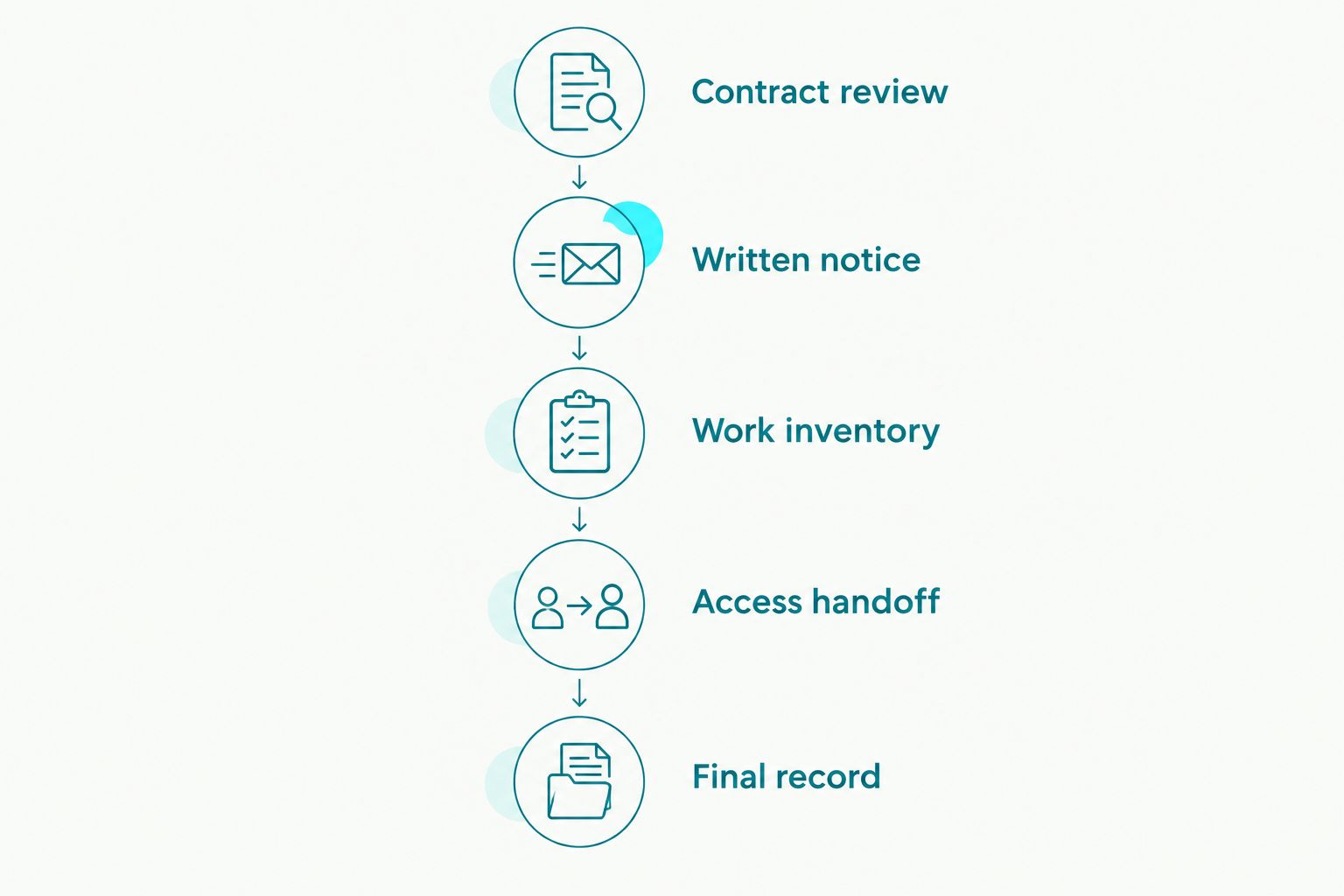
- Contract review. Find the termination clause, notice method, cure period, cancellation terms, dispute process, confidentiality duties, and ownership language. Check whether the statement of work adds project-specific rules that differ from the main agreement.
- Written notice. State that the engagement is ending, identify the contractual basis, and give the effective date. If the agreement requires notice through a platform, email address, or named contact, use that method.
- Work inventory. List completed, accepted, rejected, and unfinished deliverables separately. For hourly work, compare submitted time with the tasks and records required by the agreement.
- Access handoff. Identify every system the marketer can enter and every asset the marketer controls. Assign an internal owner for Google Ads, Meta Ads, HubSpot, Salesforce, Zapier, analytics, file storage, passwords, and scheduled content.
- Final record. Keep the notice, response, invoices, approvals, change requests, exported files, and access log together. Record which obligations remain active after termination, including confidentiality or data deletion duties stated in the contract.
Do not ask the freelancer to complete new tasks during the handoff unless you also define whether those tasks fall inside the existing scope. A termination process becomes another scope dispute when the final request quietly expands the work.
Find your next marketing specialist
Connect with vetted marketing, CRM, automation, and growth professionals for defined project work.
Find freelance talentCan you terminate for missed deadlines or poor work?
You can rely on missed deadlines or unacceptable work when the contract makes those items enforceable obligations and your records show the failure. Compare the actual delivery with the agreed deadline, acceptance criteria, revision process, and dependencies assigned to your team.
A deadline is harder to enforce when your team delivered required information late or left approvals pending. Separate delays caused by the freelancer from delays caused by missing access, changed scope, unavailable stakeholders, or unanswered questions.
Poor performance also needs a written standard. Statements such as “the campaign feels wrong” or “the copy is not strong enough” do not identify a contractual failure. Point to the brief, approved examples, technical requirements, brand rules, or acceptance criteria that the work missed.
If the contract includes a cure process, follow it. Describe the failure, identify the required correction, and use the contract’s stated deadline. In 2026, a clear cure notice creates a stronger record than a sequence of vague Slack messages expressing frustration.
Do not label a strategic disagreement as misconduct. A freelancer can recommend a channel, audience, or campaign direction that you reject without breaching the agreement. Terminate for convenience if the real issue is that the business wants a different approach.
Can you end the project when the freelancer did nothing wrong?
Yes, if the contract allows termination for convenience or the freelancer accepts a mutual termination. Follow the notice, cancellation, and payment provisions rather than inventing a performance failure.
Common business reasons include a paused campaign, revised budget, leadership change, internal hire, product delay, or a decision to move work to an agency. Those reasons explain the decision, but they do not erase contractual obligations already created.
State the business reason briefly and avoid accusations. Then address completed work, work in progress, approved expenses, account access, confidential information, and ownership. A neutral notice is easier to act on than a message that mixes operational instructions with blame.
A Talent Tasker freelance marketplace search can help identify another marketing or CRM professional when replacement is necessary. The limitation is straightforward: sourcing a replacement does not decide whether the existing contract was terminated correctly.
Why termination risk varies
The risk of a mid-project termination in 2026 depends on the documents and work history, not the job title alone.
- Termination language: A clear clause defines the permitted reasons, required notice, effective date, and delivery method. Silence forces the parties to rely on other contract terms and applicable law.
- Project structure: Hourly work raises questions about recorded time and approved tasks. Fixed-scope work raises questions about milestone completion, acceptance, and the value of partial deliverables.
- Change control: Written change requests show whether new tasks replaced the original scope or were added to it. Verbal changes leave both sides with different versions of the project.
- Acceptance records: Approvals, requested revisions, and rejection reasons establish which deliverables the business accepted before termination.
- Asset ownership: The agreement should address final files, working files, campaign assets, intellectual property, and any pre-existing materials the freelancer brought to the project.
- System access: The more accounts, automations, and scheduled activities involved, the more detailed the handoff needs to be.
Talent Tasker connects businesses with freelance marketing, CRM, automation, and growth professionals, but every project still needs a precise scope. Define the deliverable, owner, deadline, acceptance process, and termination path before work starts.
How should you handle payment for completed work?
Pay undisputed amounts according to the contract and invoice terms. If part of an invoice is disputed, identify the exact hours, milestone, expense, or deliverable in question rather than withholding everything without explanation.
For fixed-scope work, determine whether the agreement ties payment to submission, acceptance, or a named milestone. A draft can be valuable work without satisfying the acceptance standard, so the contract needs to resolve that distinction.
For hourly work, review the required time records and task approvals. Do not create a new documentation requirement after termination and use it to reject records that previously followed the accepted process.
Avoid making payment conditional on tasks the contract did not require. If you need additional exports, documentation, training, or cleanup, agree in writing on whether that work belongs to the existing handoff or requires a separate arrangement.
No universal amount applies to a freelance marketer terminated mid-project in 2026. The amount depends on the contract, accepted work, recorded hours, approved expenses, cancellation terms, and any valid dispute over performance.
How do you transfer accounts and campaign assets safely?
Build the access list before sending termination notice when the contract and circumstances permit. The goal is not to hide the decision; it is to ensure the business knows which systems need an owner and which actions could interrupt active campaigns.
Confirm that the business controls the primary administrator account, recovery email, payment method, domain, analytics property, CRM portal, and file repository. Transfer business-owned files into approved storage and preserve their original structure where possible.
On the effective termination date, remove access that is no longer authorized. Check direct user accounts, shared credentials, API keys, connected apps, Zapier connections, scheduled social tools, reporting connectors, and delegated administrator roles.
Do not delete the freelancer’s records merely because the engagement ended. Keep relevant project communications, approvals, invoices, and access logs under your normal retention policy and any contractual or legal requirements.
Do you need a lawyer to fire a freelance marketer?
You do not need a lawyer for every routine contract termination, but legal review is appropriate when the agreement is unclear, the amount is disputed, sensitive data is involved, threats have been made, or either side alleges breach. A lawyer licensed in the relevant jurisdiction can interpret the contract and applicable law.
Operational advice is not a substitute for legal advice. Use the process on this page to organize the facts, then get counsel when the risk exceeds a normal project handoff.
Can you replace the freelancer before termination is complete?
You can begin planning for a replacement, but do not give a new contractor access to confidential files or disputed work without confirming your rights. Preserve the current project record before another person edits campaigns, automations, copy, or CRM data.
A replacement brief should explain the remaining deliverables, existing systems, approved strategy, known problems, and decision owners. Do not ask the replacement to reconstruct the dispute; ask them to complete a clearly defined new scope.
What should the termination message include?
The message should identify the contract, state the termination basis, give the effective date, explain the required handoff, and address undisputed payment. Keep the wording factual and connect every performance claim to a dated obligation or deliverable.
Include where files must be delivered, which systems require transfer, who will receive questions, and which post-termination duties remain active under the agreement. Do not add threats, personal criticism, or claims you cannot document.
FAQ
Can you fire a freelance marketer mid-project?
Yes, you can end a freelance marketing contract mid-project when the agreement permits termination or both sides consent. Follow the contract’s notice, payment, ownership, and handoff terms.
Can you fire a freelancer without warning?
You can terminate without advance warning only when the contract and applicable law allow it. Check for notice and cure requirements before making the termination effective.
Do you have to pay a freelancer after firing them?
You must handle payment according to the contract, accepted deliverables, recorded hours, approved expenses, and applicable law. Pay undisputed amounts and document any specific dispute.
Can a freelancer keep unfinished marketing work?
The contract determines who controls unfinished work, drafts, source files, and pre-existing materials. Do not assume payment or possession automatically transfers every right.
Should you remove a freelancer from Google Ads immediately?
Remove access when it is no longer authorized, while following the contract and preserving the project record. Confirm that the business controls administration, billing, recovery, and campaign assets first.
What counts as cause for terminating a freelance marketer?
Cause is a documented failure that meets the contract’s definition of breach. Missed written obligations, failed acceptance criteria, or abandonment can qualify when the facts and agreement support them.
Is Talent Tasker suitable for replacing a freelance marketer?
Talent Tasker is suitable for businesses seeking vetted marketing, CRM, automation, and growth professionals for project-based or hourly work. Define the replacement scope separately from the terminated engagement.
How do you avoid a dispute when ending a freelance contract?
Follow the termination clause, use written notice, separate accepted work from disputed work, and document payment and access changes. Get legal advice when the contract or facts are contested.
One last thing
Creating a campaign does not necessarily make someone the owner or administrator of the account that contains it. Before ending the project in 2026, test your own administrator access to Google Ads, Meta Ads, HubSpot, Salesforce, analytics, file storage, and connected automations.
Do this from the business-controlled account, not from the freelancer’s login. A written handoff is useful, but verified access is what keeps the work usable after the relationship ends.
Related guides
- Best freelance marketplaces for marketing talent
- Best platforms for hiring HubSpot freelance experts
- Freelance growth marketer versus agency